

Best Marine Batteries for Yachts 2026: Lead-Acid vs AGM vs Lithium
Marine
- Sponsor
- OPTIMA Batteries
- Location
- Pass Christian, MS


If you have a sailboat or motor yacht, you are likely the owner of multiple batteries for that vessel. Those batteries could include banks for bow thrusters, stern thrusters, house batteries and starting batteries for engines and generators. It's not uncommon for some of these boats to have a dozen or more such batteries, deployed for a variety of uses. Flooded lead-acid batteries have traditionally been the least expensive option to purchase, but even ten or twelve of those batteries can quickly turn into a four-figure investment. The three most common technologies currently in use are flooded lead-acid, Absorbed Glass Mat (AGM) lead-acid and lithium batteries. Which one is the best choice? There's no single answer to cover every yacht, but we can look at some factors that should be considered when making this decision.
Price
The first number many people look at when battery shopping is price. As we mentioned, flooded lead-acid batteries are generally the least expensive option in terms of upfront cost. However, AGM and lithium options that may cost more initially can end up being a less expensive option over time, if the boat owner holds onto the vessel long enough and/or cycles the batteries often enough. The reason is that while flooded lead-acid batteries may be the least expensive purchase option, they typically offer the shortest lifespan of the three technologies, especially if they are not properly maintained. They may also see diminishing performance sooner than AGM or lithium batteries and may only provide a fraction of the Ah rating in practical use.
The Case for Flooded Batteries
Flooded lead-acid batteries do have a place. If you are not planning on holding onto your vessel, they may be the best option, as you are unlikely to recoup the incremental cost in outfitting your boat with AGM or lithium batteries. They also offer charger compatibility not always found with lithium batteries. The vast majority of boats are equipped with charging systems that can maintain flooded or AGM lead-acid batteries. If you need to replace a battery, replacing a flooded lead-acid battery is often the easiest proposition, as they are found nearly everywhere batteries are sold.
Ideally, any banks of two or more batteries should be identical in age, size and type, but if you are in a remote area and in need of a battery, you'll take what you can get and deal with the long-term lifespan concerns when you have more viable options. What you may end up doing later in a scenario where you replace one of four house batteries, is when you do make it to an area where you have some choices, you could move those batteries to applications where identical pairs can be matched or batteries can be used singularly. Then, you can outfit the four-battery bank with a matched set of new batteries in the technology of your choosing to maximize performance and lifespan.
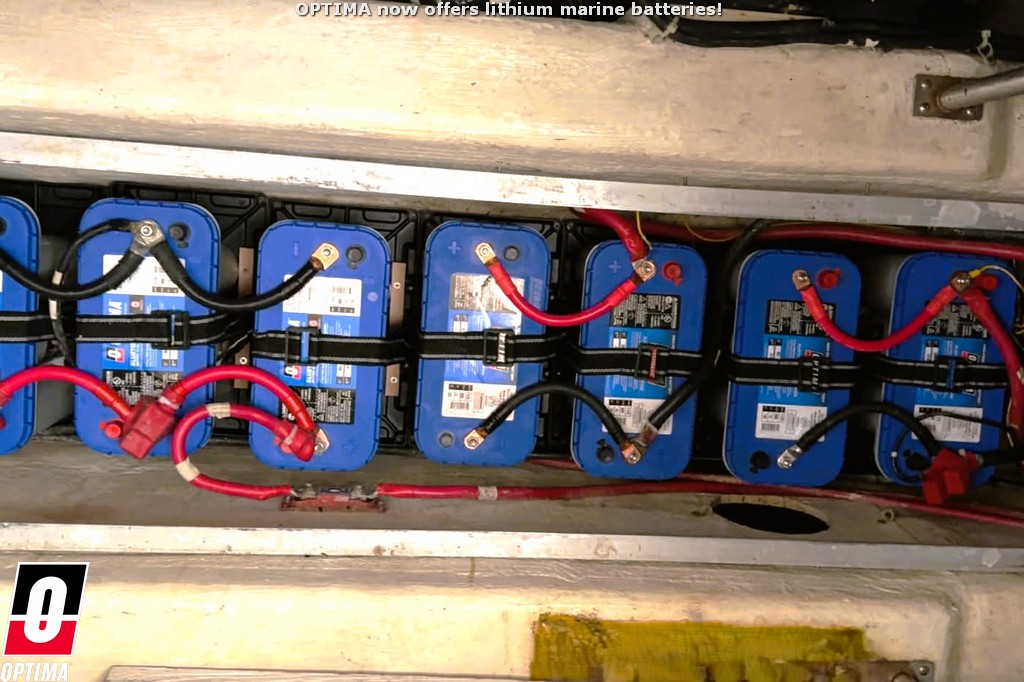
Flooded batteries do require critical additional maintenance beyond regular maintenance charging, in the form of periodically adding distilled water. While that is not a difficult task, it is often forgotten or overlooked, but if well maintained, some high-quality flooded lead-acid batteries can offer very solid performance. The OPTIMA BLUETOPs pictured above are part of eight batteries that replaced two large (8D) flooded engine starting batteries and four 6V flooded house batteries. The previous owner had not added water to those flooded batteries in quite a while and by the time it was added, six batteries easily took five gallons of water. Many of the cells were exposed and drying out, which helped explain the lack of capacity in the house bank. If you don't believe you'll have it in you to properly maintain flooded lead-acid batteries, spend the extra money and get AGM or lithium batteries that don't need watering.
Cycle Life
Of the three technologies, flooded lead-acid will typically offer the shortest cycle life and in practical usage, the least amount of capacity versus ratings, when compared to AGM or lithium batteries. Peukert's Law essentially indicates the faster you draw current, the less total energy you'll get out of a lead-acid battery. We've also observed that the more deeply you cycle a lead-acid battery, the fewer cycles you are likely to get out of it.
A fridge on a typical yacht might draw 30Ah a day in cold weather, but that same fridge could draw 80Ah/day in hot weather. To keep the math simple, we'll compare three battery banks rated at 200Ah between flooded, AGM and lithium. To maximize performance and lifespan from the flooded bank, you probably won't want to use more than 30-40% of the capacity before recharging. That makes running the fridge no problem in cold weather, but it can become an issue in hotter weather, especially if there are other electrical demands.
AGM batteries can often be cycled at 40-50% of their rated capacity and deliver more cycles than a flooded battery, so they will often offer better performance across the board than flooded options, but they are still subject to Peukert's Law as they are discharged. Quality lithium batteries (and we have to make that distinction, because not all lithium batteries are of equal quality) can often deliver 80-90% of their rated capacity without issue and they can deliver up to ten times more cycles over the life of a battery when compared to AGM, which offers superior cycling (up to 3X for OPTIMA) when compared to flooded lead-acid batteries.
When batteries are being tested, lead-acid battery testing ends when the batteries reach 50% of their rated capacity, while the cutoff for lithium is 80% of their rated capacity, because it takes so many more cycles just to get to that point. A quality lithium battery is the clear winner when it comes to cycle life and capacity and could be the last battery you ever need to buy for your boat. However, a lithium battery that doesn't deliver can be a customer service and warranty nightmare, as we've observed in countless groups and forums. If a lithium battery brand doesn't have a physical commercial (not residential) address with a sign out front and an 800 number they answer during normal business hours, that is a strong indication of how helpful they might be if you ever encounter issues.
The Case for AGM Batteries
AGM batteries offer a reasonable middle ground between flooded lead-acid batteries and lithium batteries, from both a price and performance standpoint. AGM batteries typically don't require changes to existing battery charging systems, as some lithium batteries may, but they can deliver superior performance and lifespan to their flooded counterparts without the need to add water to the batteries. Look at how you use your boat. If your boat spends most of its life on shore power and your time on the hook is typically a weekend afternoon and/or occasional overnight, AGM batteries make a lot of sense. That's especially true if you also run your generator periodically when not on shore power.
Some boaters may get tempted by the superior Ah rating and cycle life capabilities of lithium batteries and believe that is their ultimate off grid solution, but that often ends up not being the case. Depending on the size of the boat, the number of air conditioning units and the amount of energy they draw, just the demand for air conditioning can increase overall electrical demand by five to ten times from what is drawn by a refrigerator, lights, outlets, etc... Even one AC unit pulling 800W while running at 60% afternoon duty cycle plus overnight use can pull hundreds of Ah from a battery bank in a single day. That is often well beyond the capacity of some lithium house batteries, making a more practical solution to just start the generator to cool the boat off.
What About Wind and Solar?
Boaters can charge their batteries with wind and solar energy collection, but that is more often supplemental and only sustainable when done in conjunction with conservative electrical use. In short, you're probably not going to run your air conditioning indefinitely, even with a large capacity lithium bank, maintained only by solar panels and/or wind turbines.
When Does Lithium Make Sense?
A strong case can be made for lithium batteries in trolling motor applications on fishing boats, but for the purposes of yachting, we're looking at different variables. Those who spend extended time at sea or not connected to shore power are ideal candidates for lithium batteries that have much greater storage capacity and cycle life. Lithium batteries are very efficient at accepting and delivering current, so they can perform better with solar/wind-powered chargers, as well as when the generator is powering battery chargers.
To use the Great Loop as an example, Loopers who spend most of their nights anchored out or on mooring balls would likely benefit more from lithium batteries, than Loopers who frequent marinas and yacht clubs with plenty of shore power along the route.
Look for Quality
In those instances, quality lithium batteries do make sense, but what is a "quality" lithium battery and how can you identify it? Quality lithium batteries will be UL listed and IEC rated for safety. All OPTIMA lithium batteries have met UL (US) and IEC (Euro/International) safety standards at both the cell level and the battery level. Lithium batteries used in marine applications should also be IP67-rated against water intrusion. That is an important designation, because batteries in marine environment will get wet and they need to be protected from moisture when that happens.
Lithium batteries have been popular in tournament bass fishing since about 2019 and we've interviewed hundreds of tournament anglers over the years. We've found the vast majority of tournament anglers who are using lithium batteries are not on their first set. If those batteries delivered the cycle life they promised, even a pro angler, who spends 200+ days a year on the water, should easily see 10 years or more of use, before the batteries need replacing.
Why are those lithium batteries being replaced so soon? The most common failure mode reported to us is water intrusion into the case. When that happens, it's a real issue, whether you're anchored in the Outer Abacos or fishing a tournament on Lake Guntersville. It may take some real effort to find a brick & mortar battery retailer, let alone one who carries the specific brand of lithium batteries you are running...if they are even available offline. Don't roll the dice on unfamiliar battery brands or those that haven't met essential safety and maritime standards. While that is especially true for lithium batteries, it also holds true for AGM and flooded lead-acid batteries.
You can find OPTIMA batteries at quality retailers nationwide or you can order factory-direct on our website.
Price
The first number many people look at when battery shopping is price. As we mentioned, flooded lead-acid batteries are generally the least expensive option in terms of upfront cost. However, AGM and lithium options that may cost more initially can end up being a less expensive option over time, if the boat owner holds onto the vessel long enough and/or cycles the batteries often enough. The reason is that while flooded lead-acid batteries may be the least expensive purchase option, they typically offer the shortest lifespan of the three technologies, especially if they are not properly maintained. They may also see diminishing performance sooner than AGM or lithium batteries and may only provide a fraction of the Ah rating in practical use.
The Case for Flooded Batteries
Flooded lead-acid batteries do have a place. If you are not planning on holding onto your vessel, they may be the best option, as you are unlikely to recoup the incremental cost in outfitting your boat with AGM or lithium batteries. They also offer charger compatibility not always found with lithium batteries. The vast majority of boats are equipped with charging systems that can maintain flooded or AGM lead-acid batteries. If you need to replace a battery, replacing a flooded lead-acid battery is often the easiest proposition, as they are found nearly everywhere batteries are sold.
Ideally, any banks of two or more batteries should be identical in age, size and type, but if you are in a remote area and in need of a battery, you'll take what you can get and deal with the long-term lifespan concerns when you have more viable options. What you may end up doing later in a scenario where you replace one of four house batteries, is when you do make it to an area where you have some choices, you could move those batteries to applications where identical pairs can be matched or batteries can be used singularly. Then, you can outfit the four-battery bank with a matched set of new batteries in the technology of your choosing to maximize performance and lifespan.
Flooded batteries do require critical additional maintenance beyond regular maintenance charging, in the form of periodically adding distilled water. While that is not a difficult task, it is often forgotten or overlooked, but if well maintained, some high-quality flooded lead-acid batteries can offer very solid performance. The OPTIMA BLUETOPs pictured above are part of eight batteries that replaced two large (8D) flooded engine starting batteries and four 6V flooded house batteries. The previous owner had not added water to those flooded batteries in quite a while and by the time it was added, six batteries easily took five gallons of water. Many of the cells were exposed and drying out, which helped explain the lack of capacity in the house bank. If you don't believe you'll have it in you to properly maintain flooded lead-acid batteries, spend the extra money and get AGM or lithium batteries that don't need watering.
Cycle Life
Of the three technologies, flooded lead-acid will typically offer the shortest cycle life and in practical usage, the least amount of capacity versus ratings, when compared to AGM or lithium batteries. Peukert's Law essentially indicates the faster you draw current, the less total energy you'll get out of a lead-acid battery. We've also observed that the more deeply you cycle a lead-acid battery, the fewer cycles you are likely to get out of it.
A fridge on a typical yacht might draw 30Ah a day in cold weather, but that same fridge could draw 80Ah/day in hot weather. To keep the math simple, we'll compare three battery banks rated at 200Ah between flooded, AGM and lithium. To maximize performance and lifespan from the flooded bank, you probably won't want to use more than 30-40% of the capacity before recharging. That makes running the fridge no problem in cold weather, but it can become an issue in hotter weather, especially if there are other electrical demands.
AGM batteries can often be cycled at 40-50% of their rated capacity and deliver more cycles than a flooded battery, so they will often offer better performance across the board than flooded options, but they are still subject to Peukert's Law as they are discharged. Quality lithium batteries (and we have to make that distinction, because not all lithium batteries are of equal quality) can often deliver 80-90% of their rated capacity without issue and they can deliver up to ten times more cycles over the life of a battery when compared to AGM, which offers superior cycling (up to 3X for OPTIMA) when compared to flooded lead-acid batteries.
When batteries are being tested, lead-acid battery testing ends when the batteries reach 50% of their rated capacity, while the cutoff for lithium is 80% of their rated capacity, because it takes so many more cycles just to get to that point. A quality lithium battery is the clear winner when it comes to cycle life and capacity and could be the last battery you ever need to buy for your boat. However, a lithium battery that doesn't deliver can be a customer service and warranty nightmare, as we've observed in countless groups and forums. If a lithium battery brand doesn't have a physical commercial (not residential) address with a sign out front and an 800 number they answer during normal business hours, that is a strong indication of how helpful they might be if you ever encounter issues.
The Case for AGM Batteries
AGM batteries offer a reasonable middle ground between flooded lead-acid batteries and lithium batteries, from both a price and performance standpoint. AGM batteries typically don't require changes to existing battery charging systems, as some lithium batteries may, but they can deliver superior performance and lifespan to their flooded counterparts without the need to add water to the batteries. Look at how you use your boat. If your boat spends most of its life on shore power and your time on the hook is typically a weekend afternoon and/or occasional overnight, AGM batteries make a lot of sense. That's especially true if you also run your generator periodically when not on shore power.
Some boaters may get tempted by the superior Ah rating and cycle life capabilities of lithium batteries and believe that is their ultimate off grid solution, but that often ends up not being the case. Depending on the size of the boat, the number of air conditioning units and the amount of energy they draw, just the demand for air conditioning can increase overall electrical demand by five to ten times from what is drawn by a refrigerator, lights, outlets, etc... Even one AC unit pulling 800W while running at 60% afternoon duty cycle plus overnight use can pull hundreds of Ah from a battery bank in a single day. That is often well beyond the capacity of some lithium house batteries, making a more practical solution to just start the generator to cool the boat off.
What About Wind and Solar?
Boaters can charge their batteries with wind and solar energy collection, but that is more often supplemental and only sustainable when done in conjunction with conservative electrical use. In short, you're probably not going to run your air conditioning indefinitely, even with a large capacity lithium bank, maintained only by solar panels and/or wind turbines.
When Does Lithium Make Sense?
A strong case can be made for lithium batteries in trolling motor applications on fishing boats, but for the purposes of yachting, we're looking at different variables. Those who spend extended time at sea or not connected to shore power are ideal candidates for lithium batteries that have much greater storage capacity and cycle life. Lithium batteries are very efficient at accepting and delivering current, so they can perform better with solar/wind-powered chargers, as well as when the generator is powering battery chargers.
To use the Great Loop as an example, Loopers who spend most of their nights anchored out or on mooring balls would likely benefit more from lithium batteries, than Loopers who frequent marinas and yacht clubs with plenty of shore power along the route.
Look for Quality
In those instances, quality lithium batteries do make sense, but what is a "quality" lithium battery and how can you identify it? Quality lithium batteries will be UL listed and IEC rated for safety. All OPTIMA lithium batteries have met UL (US) and IEC (Euro/International) safety standards at both the cell level and the battery level. Lithium batteries used in marine applications should also be IP67-rated against water intrusion. That is an important designation, because batteries in marine environment will get wet and they need to be protected from moisture when that happens.
Lithium batteries have been popular in tournament bass fishing since about 2019 and we've interviewed hundreds of tournament anglers over the years. We've found the vast majority of tournament anglers who are using lithium batteries are not on their first set. If those batteries delivered the cycle life they promised, even a pro angler, who spends 200+ days a year on the water, should easily see 10 years or more of use, before the batteries need replacing.
Why are those lithium batteries being replaced so soon? The most common failure mode reported to us is water intrusion into the case. When that happens, it's a real issue, whether you're anchored in the Outer Abacos or fishing a tournament on Lake Guntersville. It may take some real effort to find a brick & mortar battery retailer, let alone one who carries the specific brand of lithium batteries you are running...if they are even available offline. Don't roll the dice on unfamiliar battery brands or those that haven't met essential safety and maritime standards. While that is especially true for lithium batteries, it also holds true for AGM and flooded lead-acid batteries.
You can find OPTIMA batteries at quality retailers nationwide or you can order factory-direct on our website.