
Great Loop Chronicles Part 18
Marine
- Sponsor
- OPTIMA Batteries
- Location
- Demopolis, AL


The Great Loop Chronicles will be an ongoing series, following the travels of OPTIMA Batteries staffer, Jim McIlvaine, as he travels America's Great Loop, a 6000+ nautical mile journey around the Eastern United States.
While we're trying not to set many timing goals and deadlines on the Great Loop, we were really hoping we could reach Pass Christian, Mississippi, before OPTIMA's Ultimate Street Car series weekend in New Orleans. Gwendolyn's family lives in the area and we'd plan to stay there through the Redcrest fishing tournament the following weekend and then continue on with our trip. In order to do that, we'd need to make some time and cover some water. We haven't exactly been doing that so far.
We spent more than a week at Safe Harbor Aqua Yacht in Iuka, Mississippi, getting scheduled maintenance done. We also started out at a rather slow pace. That was good for fuel economy, but not so much for covering water. Leaving Columbus, Mississippi today would be different. We have a Gulf crossing coming up and in anticipation of that, I wanted to make sure the boat was capable and ready to run at speed in open water, if needed. In my mind, the time to do that is when I'm surrounded by land and relatively close to marinas and help, if needed.
Our goal today is Kingfisher Marina, which is three locks and 99 nautical miles from where we were starting at Columbus. If we made it, it would be the most miles we've covered in a day by about 25 miles. We carefully navigated the shallow waters around Columbus at about 6:30AM and made the short run to the first lock. My plan was to run at 2,200 rpms all day long. I didn't know how the boat would run, how much we'd be able to run at that speed because of traffic, docks, locks, etc... or how much fuel we'd use, but I felt today was the day to answer those questions. As a frame of reference, I've been told by the previous owner and another Carver 466 owner, that the "sweet spot" for fuel economy is between 800 and 900 rpms, so we'd be going significantly faster.
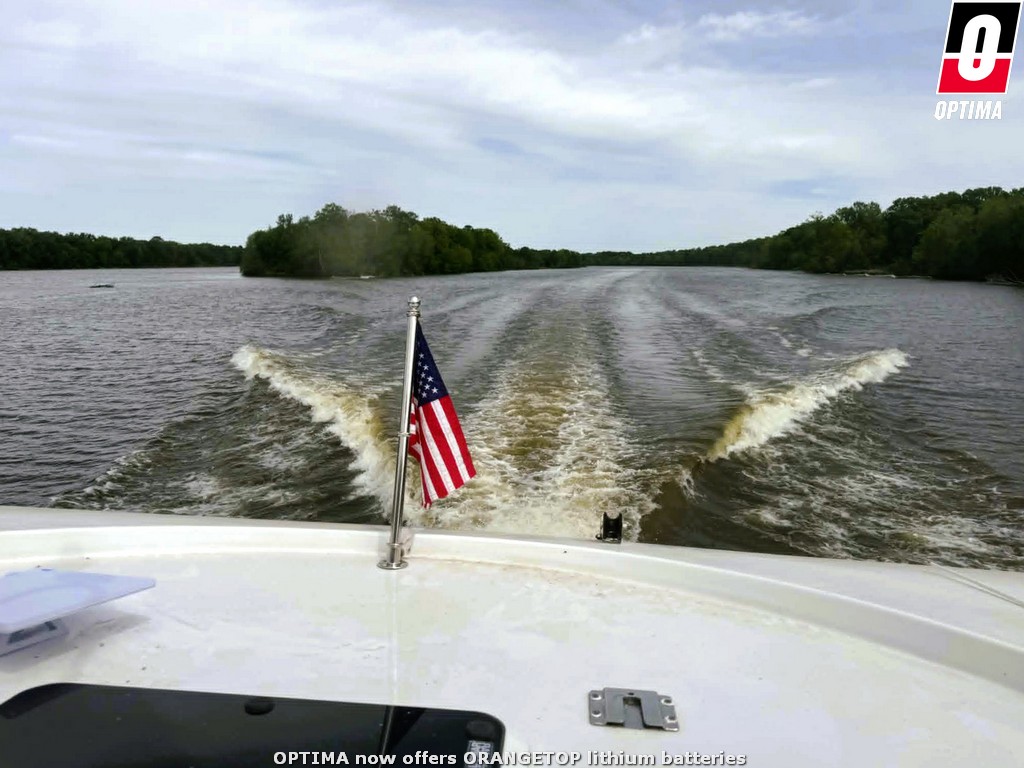
As you can see from this photo, our boat kicks out a substantial wake at just about any speed. While there are many areas of the Loop, where there are no restrictions on speed, we were still in an area with more open lake-like stretches, where I felt it would be easier to run at speed without encountering other boaters and docks that could be damaged by a big wake. I did have a fisherman on Instagram mention that he saw us coming at speed and they were getting ready to batten down the hatches, when to his surprise, we slowed down and passed him at just above idle. That's my goal- don't upset people or as I'd heard about some areas of the Tennessee river, don't give people reasons to shoot at your boat.
As I watched our wake throughout the day, I felt like the extra weight we were carrying in the aft area, between the outboard motor, the dingy, two spare props and seven batteries, was making our wake even larger and probably having a negative impact on our fuel economy- easily 800+ pounds. I decided I'd leave the outboard motor in Pass Christian (I'm picking up a smaller motor in Florida) and get the batteries swapped out there as well. The props were staying, but we already had plans to make them into a coffee table, so they weren't in the way, but still easy to access, if needed.
Kingfisher Marina in Demopolis, Alabama, had a reputation as one of the nicest stops on the Loop and in our limited experience, it lived up to the billing. We arrived at about 3:15PM and even though we had plenty of daylight left, we didn't have another 81 miles of daylight to make it to our next stop. In total, we navigated the three locks and covered 99 miles, averaging about 15 knots. A lot of water and a lot of speed, which meant a lot of fuel consumed- 201 gallons at the pump! That was a four-figure fuel bill in a single day, but I now know we get about a half mile to the gallon at 15 knots...in relatively calm conditions. With a 480-gallon fuel capacity, that gives me a conservative range of more than 200 miles at that speed, which is more than enough to make a longer Gulf crossing at speed (if conditions allow).
The shower and laundry facilities at Kingfisher were a short walk from the fuel dock and were wonderful and the staff was very accommodating, allowing us to stay overnight at the fuel dock, which had water and electric. They also had a courtesy car, which allowed us to head into town for dinner and Demopolis is a neat little town. We wish we had more time to spend there. We ate well and slept well in a marina that was dead calm. The next day would take us to the most remote stretch of the Tombigbee. How much water will we cover and how fast will we go? Read about it here.
While we're trying not to set many timing goals and deadlines on the Great Loop, we were really hoping we could reach Pass Christian, Mississippi, before OPTIMA's Ultimate Street Car series weekend in New Orleans. Gwendolyn's family lives in the area and we'd plan to stay there through the Redcrest fishing tournament the following weekend and then continue on with our trip. In order to do that, we'd need to make some time and cover some water. We haven't exactly been doing that so far.
We spent more than a week at Safe Harbor Aqua Yacht in Iuka, Mississippi, getting scheduled maintenance done. We also started out at a rather slow pace. That was good for fuel economy, but not so much for covering water. Leaving Columbus, Mississippi today would be different. We have a Gulf crossing coming up and in anticipation of that, I wanted to make sure the boat was capable and ready to run at speed in open water, if needed. In my mind, the time to do that is when I'm surrounded by land and relatively close to marinas and help, if needed.
Our goal today is Kingfisher Marina, which is three locks and 99 nautical miles from where we were starting at Columbus. If we made it, it would be the most miles we've covered in a day by about 25 miles. We carefully navigated the shallow waters around Columbus at about 6:30AM and made the short run to the first lock. My plan was to run at 2,200 rpms all day long. I didn't know how the boat would run, how much we'd be able to run at that speed because of traffic, docks, locks, etc... or how much fuel we'd use, but I felt today was the day to answer those questions. As a frame of reference, I've been told by the previous owner and another Carver 466 owner, that the "sweet spot" for fuel economy is between 800 and 900 rpms, so we'd be going significantly faster.
As you can see from this photo, our boat kicks out a substantial wake at just about any speed. While there are many areas of the Loop, where there are no restrictions on speed, we were still in an area with more open lake-like stretches, where I felt it would be easier to run at speed without encountering other boaters and docks that could be damaged by a big wake. I did have a fisherman on Instagram mention that he saw us coming at speed and they were getting ready to batten down the hatches, when to his surprise, we slowed down and passed him at just above idle. That's my goal- don't upset people or as I'd heard about some areas of the Tennessee river, don't give people reasons to shoot at your boat.
As I watched our wake throughout the day, I felt like the extra weight we were carrying in the aft area, between the outboard motor, the dingy, two spare props and seven batteries, was making our wake even larger and probably having a negative impact on our fuel economy- easily 800+ pounds. I decided I'd leave the outboard motor in Pass Christian (I'm picking up a smaller motor in Florida) and get the batteries swapped out there as well. The props were staying, but we already had plans to make them into a coffee table, so they weren't in the way, but still easy to access, if needed.
Kingfisher Marina in Demopolis, Alabama, had a reputation as one of the nicest stops on the Loop and in our limited experience, it lived up to the billing. We arrived at about 3:15PM and even though we had plenty of daylight left, we didn't have another 81 miles of daylight to make it to our next stop. In total, we navigated the three locks and covered 99 miles, averaging about 15 knots. A lot of water and a lot of speed, which meant a lot of fuel consumed- 201 gallons at the pump! That was a four-figure fuel bill in a single day, but I now know we get about a half mile to the gallon at 15 knots...in relatively calm conditions. With a 480-gallon fuel capacity, that gives me a conservative range of more than 200 miles at that speed, which is more than enough to make a longer Gulf crossing at speed (if conditions allow).
The shower and laundry facilities at Kingfisher were a short walk from the fuel dock and were wonderful and the staff was very accommodating, allowing us to stay overnight at the fuel dock, which had water and electric. They also had a courtesy car, which allowed us to head into town for dinner and Demopolis is a neat little town. We wish we had more time to spend there. We ate well and slept well in a marina that was dead calm. The next day would take us to the most remote stretch of the Tombigbee. How much water will we cover and how fast will we go? Read about it here.