

Great Loop Chronicles Part 23
Marine
- Sponsor
- OPTIMA Batteries
- Location
- Pass Christian, MS


The Great Loop Chronicles will be an ongoing series, following the travels of OPTIMA Batteries staffer, Jim McIlvaine, as he travels America's Great Loop, a 6000+ nautical mile journey around the Eastern United States.
I have no trouble admitting it felt good to be off the boat for a few days. It's a bigger adjustment than I expected to go from living on land to living on a boat. I found the constant movement of the boat in Pass Christian Harbor gave me "sea legs" that made the transition back to land noticeable. It was nice just being a few steps away from a bathroom that had some space in it. I was still stressed about the trip but couldn't put my finger on what the source was other than the unknown variables that we could encounter along the way and how we'd deal with them.
Pass Christian Yacht Works isn't set up for people to live aboard boats while work is being done, which wasn't a problem for us, since my wife's family lives in Pass Christian. The battery swap work also took a while, although that wasn't a surprise to me, as I just plan for these types of things to run long and if they don't, it's a bonus. While that work was ongoing, I made my way to Missouri for the Major League Fishing Redcrest tournament, while Gwendolyn spent time with her family, caught up with old friends and visited more museums with the kids.
The Redcrest tournament didn't go the way OPTIMA-sponsored angler, Edwin Evers hoped it would for him, but we had a great talk about the Great Loop, which is a trip he's wanted to take for quite some time. He's already fished much of the river sections in bass tournaments, but he'd love to find a way to do the rest. As we talked about our upcoming transit across the Gulf, he indicated he'd like to join us for that leg. He has a Heavy Hitters bass tournament to fish in Florida in the middle of May, so he could work his way over beforehand and make the crossing with us.
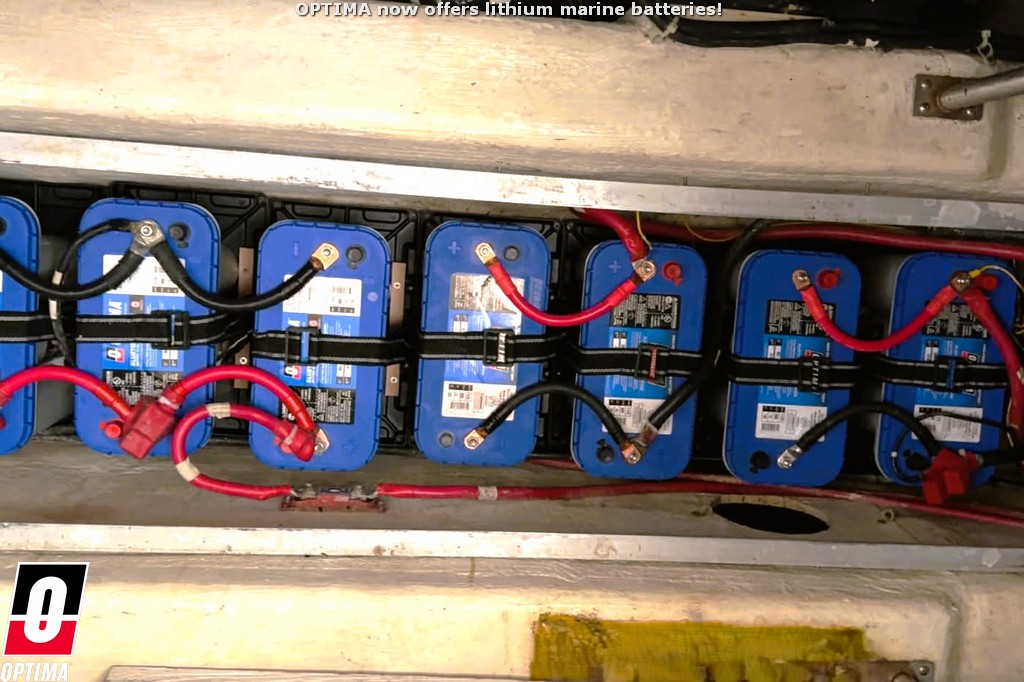
Back in Pass Christian, the batteries were getting installed and the team at Pass Christian Yacht Works made sure it was done the right way, with each battery properly secured in its own tray. While Carver used two 8D batteries to start the twin Volvo diesels, the battery compartment had enough room to replace them both with two pairs of Group 31 batteries, which are much easier to move around.
The four 6-volt house batteries were replaced with four Group 31 batteries, so eight batteries in total were dropped into the battery compartment that once held two 8D batteries and four 6V house batteries. In terms of starting power, the two D31M BLUETOPs are rated at 1,800 CCA, compared to the 1,425 CCA in the 8Ds they replaced. The four D31M BLUETOP batteries covering house duty are rated at 300Ah, while the four 6-volt house batteries they replaced had a total capacity on paper of 860Ah.
The usable capacity of AGM batteries is about half their rating, so the OPTIMAs are really about 150Ah, while the flooded lead-acid house batteries they replaced might've been less than 400Ah on paper. In practical use, the capacity on the old house batteries seemed to have drop far below that mark, where I had low voltage alarms sounding on the house bank, when we were anchored out overnight, leading us to run the generator to provide power and charge them. I didn't expect the new bank to be challenged anytime soon.
After spending more than two weeks at Pass Christin, we were finally ready to rejoin the Great Loop route and head East. Read about the next stage of the journey here.
I have no trouble admitting it felt good to be off the boat for a few days. It's a bigger adjustment than I expected to go from living on land to living on a boat. I found the constant movement of the boat in Pass Christian Harbor gave me "sea legs" that made the transition back to land noticeable. It was nice just being a few steps away from a bathroom that had some space in it. I was still stressed about the trip but couldn't put my finger on what the source was other than the unknown variables that we could encounter along the way and how we'd deal with them.
Pass Christian Yacht Works isn't set up for people to live aboard boats while work is being done, which wasn't a problem for us, since my wife's family lives in Pass Christian. The battery swap work also took a while, although that wasn't a surprise to me, as I just plan for these types of things to run long and if they don't, it's a bonus. While that work was ongoing, I made my way to Missouri for the Major League Fishing Redcrest tournament, while Gwendolyn spent time with her family, caught up with old friends and visited more museums with the kids.
The Redcrest tournament didn't go the way OPTIMA-sponsored angler, Edwin Evers hoped it would for him, but we had a great talk about the Great Loop, which is a trip he's wanted to take for quite some time. He's already fished much of the river sections in bass tournaments, but he'd love to find a way to do the rest. As we talked about our upcoming transit across the Gulf, he indicated he'd like to join us for that leg. He has a Heavy Hitters bass tournament to fish in Florida in the middle of May, so he could work his way over beforehand and make the crossing with us.
Back in Pass Christian, the batteries were getting installed and the team at Pass Christian Yacht Works made sure it was done the right way, with each battery properly secured in its own tray. While Carver used two 8D batteries to start the twin Volvo diesels, the battery compartment had enough room to replace them both with two pairs of Group 31 batteries, which are much easier to move around.
The four 6-volt house batteries were replaced with four Group 31 batteries, so eight batteries in total were dropped into the battery compartment that once held two 8D batteries and four 6V house batteries. In terms of starting power, the two D31M BLUETOPs are rated at 1,800 CCA, compared to the 1,425 CCA in the 8Ds they replaced. The four D31M BLUETOP batteries covering house duty are rated at 300Ah, while the four 6-volt house batteries they replaced had a total capacity on paper of 860Ah.
The usable capacity of AGM batteries is about half their rating, so the OPTIMAs are really about 150Ah, while the flooded lead-acid house batteries they replaced might've been less than 400Ah on paper. In practical use, the capacity on the old house batteries seemed to have drop far below that mark, where I had low voltage alarms sounding on the house bank, when we were anchored out overnight, leading us to run the generator to provide power and charge them. I didn't expect the new bank to be challenged anytime soon.
After spending more than two weeks at Pass Christin, we were finally ready to rejoin the Great Loop route and head East. Read about the next stage of the journey here.