What are the Signs a Battery is Dying?
Do you think your car battery is nearing the end of its useful life? Are you noticing symptoms that you think might be indicating your battery is about to die? We'll help you sort out what might be going on and whether or not your battery does need to be replaced.
Start with the Voltage
Measuring battery voltage at the battery terminals is ideally the first place to start the diagnosing potential issues with your battery. While your battery may be called a "12-volt" battery, the voltage you measure should be at least 12.6 volts. It's also a good idea to measure voltage after your vehicle has been sitting for 12-24 hours, to make sure any surface charge from recent operation has dissipated. How critical is battery voltage? Whenever any lead-acid battery is discharged below 12.4 volts and is left sitting in that state, sulfation begins forming in the plates, which can diminish battery capacity and lifespan. A battery that measures 12.0 volts may seem ok, but that battery is likely to be more than 50% discharged.
If you find your battery voltage is low, fully recharge your battery to at least 12.6 volts with a quality battery charger. Your vehicle's charging system is designed to maintain battery voltage near a full state of charge, so if you try to recharge your battery by just driving your vehicle, you may put a lot of stress on your vehicle's charging system and you may not drive long enough or at a speed that will allow the charging system to fully recharge the battery.
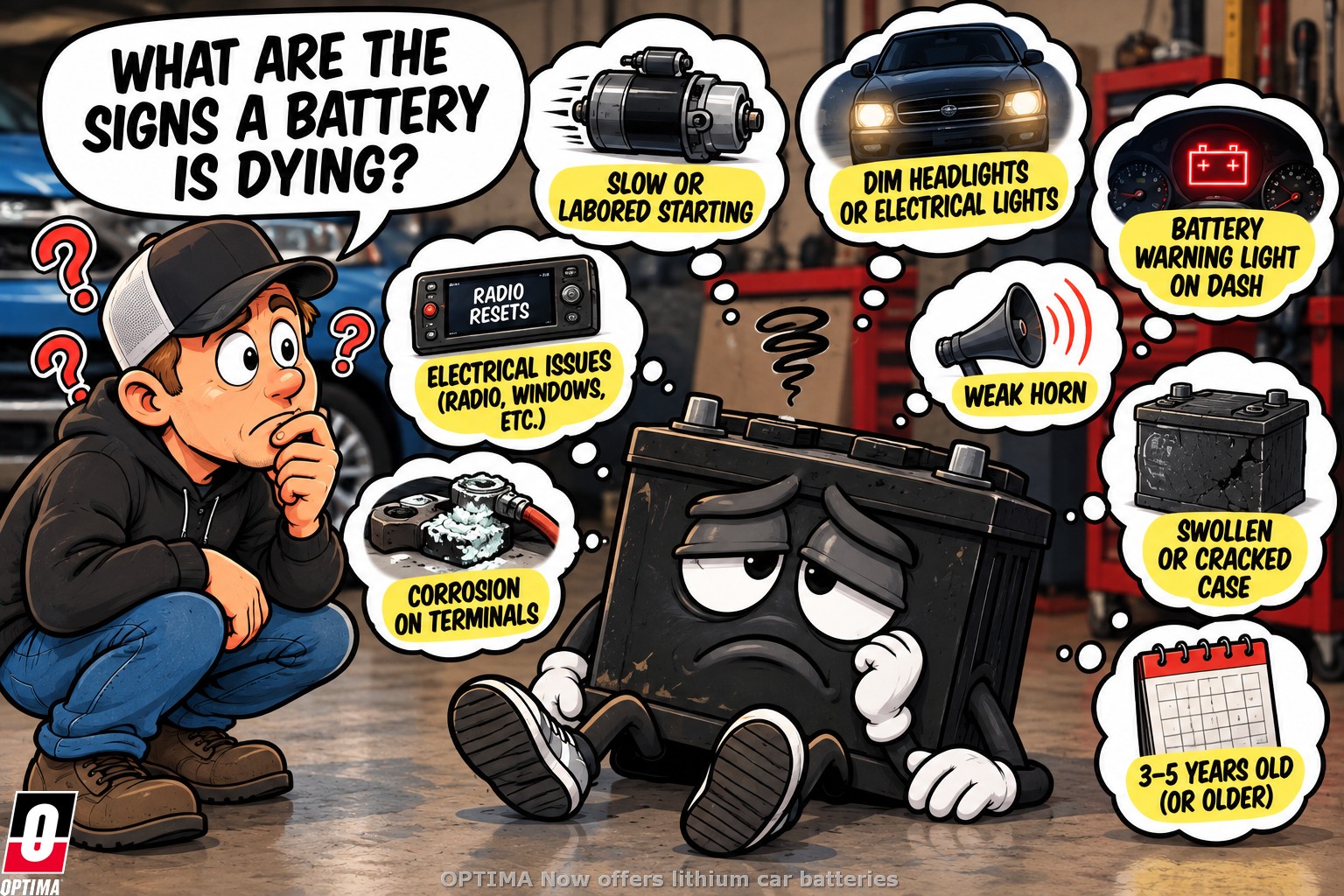
You may find by fully recharging your battery with a quality battery charger could eliminate many of the symptoms you've been noticing, like battery warning lights, issues with the radio or seat presets, slow or labored engine starting or a weak horn.
Corrosion on Terminals
OPTIMA batteries are sealed, so you'll never have to worry about corrosion on the terminals. However, if you don't have an OPTIMA battery, corrosion buildup on the terminals could make it harder for current to reach the starter, which could result in slow cranking, clicking or a no-start situation. Corrosion could also create resistance that makes lights dim or flicker or modules behave erratically. In short, corrosion may make the battery starter and alternator all work harder. That doesn't mean the battery is bad or needs to be replaced, but the terminals definitely should be cleaned.
If you only notice heavy corrosion on the positive terminal, it could indicate the battery is being overcharged. If you only notice heavy corrosion on the negative terminal, it could suggest the battery is being undercharged or there is a poor ground connection. The best thing to do is safely clean the terminals, make sure the battery is fully charged to at least 12.6 volts and continue to monitor the situation.
Dim Headlights?
The battery has basically done its job once your vehicle is started. From that point, the vehicle charging system (typically the alternator) provides electricity to run your vehicle. If your headlights dim, maybe when you are playing the radio loudly and a bass note hits hard, it means your vehicle's charging system is not able to meet the electrical demand at that moment and the battery is trying to cover the gap.
If you see your headlights dimming frequently, you may want to measure battery voltage at the battery terminals while the engine is running. That will tell you the output of your vehicle's charging system and measuring at the terminals is the best way to get an accurate measurement. The voltage should measure about 13.7-14.7 volts. However, if your measured voltage is significantly lower than that, there could be an issue with your charging system- failing alternator, loose belt, etc...
Swollen or Cracked Case?
As mentioned earlier, when batteries are discharged below 12.4 volts and are allowed to sit in that state, sulfation can form in the plates. Over time, that sulfation can build up and cause the battery case to bulge. If a battery is frozen or dropped, the case can also crack. A battery with a cracked case should be replaced immediately. A battery that is swollen may continue to operate for a period of time, but replacement should be a priority.
Is My Battery Too Old To Keep Using?
Lead-acid batteries can sometimes surprise a lot of people with their longevity. A well-maintained 12-volt lead-acid battery that is not exposed to extreme temperatures can last significantly longer than the "3-5 year" timespan frequently offered up. OPTIMA batteries can last up to three times as long as a traditional flooded lead-acid battery, but if you are unsure about where your battery is at relative to how long you've owned it, there is something you can do. Most quality battery professionals can load test your battery and many will do it for free. It doesn't even need to be removed from your vehicle.
A load test will generally give you a good idea of whether the battery needs to be replaced or can continue to be used, even if it is well beyond the three to five-year lifespan we hear about frequently. If you live in an area that sees extreme temperatures, either hot or cold, you may find yourself replacing lead-acid batteries more often, but there's something you can do to maximize the performance and lifespan of your battery- keep it topped off with a quality battery charger or maintainer.
Start with the Voltage
Measuring battery voltage at the battery terminals is ideally the first place to start the diagnosing potential issues with your battery. While your battery may be called a "12-volt" battery, the voltage you measure should be at least 12.6 volts. It's also a good idea to measure voltage after your vehicle has been sitting for 12-24 hours, to make sure any surface charge from recent operation has dissipated. How critical is battery voltage? Whenever any lead-acid battery is discharged below 12.4 volts and is left sitting in that state, sulfation begins forming in the plates, which can diminish battery capacity and lifespan. A battery that measures 12.0 volts may seem ok, but that battery is likely to be more than 50% discharged.
If you find your battery voltage is low, fully recharge your battery to at least 12.6 volts with a quality battery charger. Your vehicle's charging system is designed to maintain battery voltage near a full state of charge, so if you try to recharge your battery by just driving your vehicle, you may put a lot of stress on your vehicle's charging system and you may not drive long enough or at a speed that will allow the charging system to fully recharge the battery.
You may find by fully recharging your battery with a quality battery charger could eliminate many of the symptoms you've been noticing, like battery warning lights, issues with the radio or seat presets, slow or labored engine starting or a weak horn.
Corrosion on Terminals
OPTIMA batteries are sealed, so you'll never have to worry about corrosion on the terminals. However, if you don't have an OPTIMA battery, corrosion buildup on the terminals could make it harder for current to reach the starter, which could result in slow cranking, clicking or a no-start situation. Corrosion could also create resistance that makes lights dim or flicker or modules behave erratically. In short, corrosion may make the battery starter and alternator all work harder. That doesn't mean the battery is bad or needs to be replaced, but the terminals definitely should be cleaned.
If you only notice heavy corrosion on the positive terminal, it could indicate the battery is being overcharged. If you only notice heavy corrosion on the negative terminal, it could suggest the battery is being undercharged or there is a poor ground connection. The best thing to do is safely clean the terminals, make sure the battery is fully charged to at least 12.6 volts and continue to monitor the situation.
Dim Headlights?
The battery has basically done its job once your vehicle is started. From that point, the vehicle charging system (typically the alternator) provides electricity to run your vehicle. If your headlights dim, maybe when you are playing the radio loudly and a bass note hits hard, it means your vehicle's charging system is not able to meet the electrical demand at that moment and the battery is trying to cover the gap.
If you see your headlights dimming frequently, you may want to measure battery voltage at the battery terminals while the engine is running. That will tell you the output of your vehicle's charging system and measuring at the terminals is the best way to get an accurate measurement. The voltage should measure about 13.7-14.7 volts. However, if your measured voltage is significantly lower than that, there could be an issue with your charging system- failing alternator, loose belt, etc...
Swollen or Cracked Case?
As mentioned earlier, when batteries are discharged below 12.4 volts and are allowed to sit in that state, sulfation can form in the plates. Over time, that sulfation can build up and cause the battery case to bulge. If a battery is frozen or dropped, the case can also crack. A battery with a cracked case should be replaced immediately. A battery that is swollen may continue to operate for a period of time, but replacement should be a priority.
Is My Battery Too Old To Keep Using?
Lead-acid batteries can sometimes surprise a lot of people with their longevity. A well-maintained 12-volt lead-acid battery that is not exposed to extreme temperatures can last significantly longer than the "3-5 year" timespan frequently offered up. OPTIMA batteries can last up to three times as long as a traditional flooded lead-acid battery, but if you are unsure about where your battery is at relative to how long you've owned it, there is something you can do. Most quality battery professionals can load test your battery and many will do it for free. It doesn't even need to be removed from your vehicle.
A load test will generally give you a good idea of whether the battery needs to be replaced or can continue to be used, even if it is well beyond the three to five-year lifespan we hear about frequently. If you live in an area that sees extreme temperatures, either hot or cold, you may find yourself replacing lead-acid batteries more often, but there's something you can do to maximize the performance and lifespan of your battery- keep it topped off with a quality battery charger or maintainer.