

What Size Battery Do I Need For My Boat?
Marine
- Sponsor
- OPTIMA Batteries
- Location
- Glendale, WI


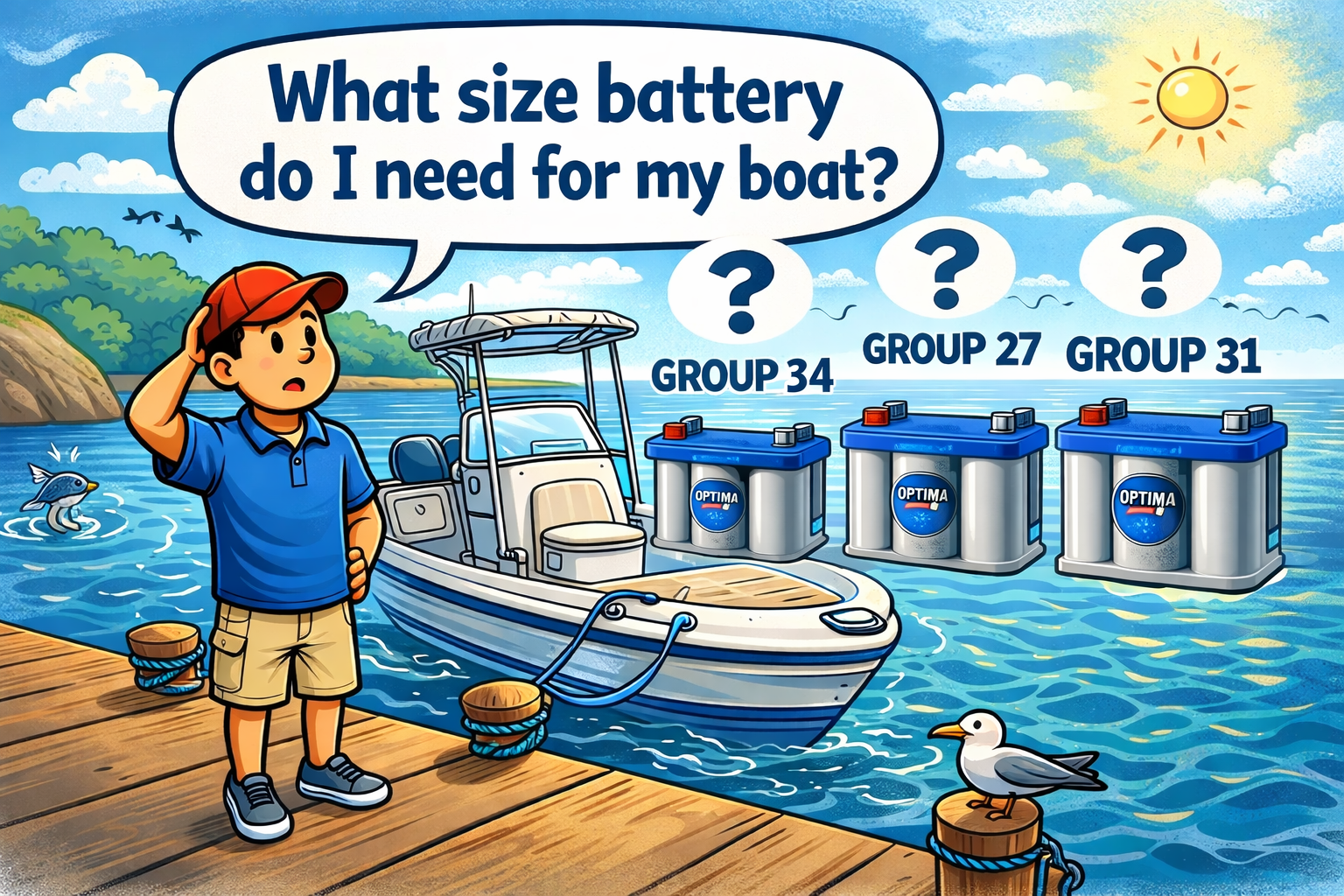
When shopping for a marine battery, there are three sizes that are most commonly used- Group 34 (or a similarly sized Group 24), Group 27 and Group 31. While the numbers associated with those batteries might suggest otherwise, the 34 (or 24) is the smallest of the three, the 27 is in the middle and the 31 is the largest. OPTIMA offers all three in our SPIRALCELL AGM lead-acid line, as well as two options for Group 31 lithium batteries. There are generally two purposes for a marine battery- engine starting and reserve power (house battery, trolling motor, other electrical accessories).
Stay With What Works or Upgrade?
If your previous marine battery had no issues with its job, whether it was engine starting or reserve power, then purchasing a similarly sized battery probably makes sense. If it struggled to start your engine or never seemed to run your trolling motor as long as you'd like, then moving to a larger size makes sense, if space on the boat allows. There is also a factor to consider regarding cycle life on lead-acid batteries (including AGM lead-acid batteries). The more deeply you cycle a lead-acid battery, the fewer cycles you are likely to get out of it, which makes a strong case for purchasing the largest lead-acid battery you can fit in the space available on your boat.
Engine Starting
For engine starting, if you know the CCA or MCA requirement of the engine, that might make the battery size an obvious choice. If not, know that Group 34 and 27 batteries are typically used to start most outboard, stern drive or inboard motors on sub-30 foot boats, while larger V8 engines and diesel engines often use a Group 31 battery.
Batteries for Reserve Power
If you are buying a marine battery for house use- lights, trolling motor, house battery, etc...), then Group 27 and Group 31 batteries are more commonly used and that's where the depth of discharge becomes a more important consideration. Marine Cranking Amps, Cranking Amps or Cold Cranking Amps aren't the important specification for these batteries, but Amp Hours (AH) or Reserve Capacity (RC), with larger numbers offering more runtime. Trolling motors will come in 12V, 24V or 36V configurations, while the vast majority of marine batteries are 12V batteries. That means, you'll need two 12V batteries wired in series to operate a 24-volt trolling motor and three 12-volt batteries wired in series to operate a 36V trolling motor and again, bigger (more AH) is often better. Anytime you connect two or more batteries in series or parallel, they should always be identical in age, size and type.
Don't Forget Proper Marine Battery Maintenance!
The key to long marine battery lifespan and maximizing marine battery performance is proper voltage maintenance. Fully charged OPTIMA BLUETOP batteries will measure about 13.0-13.2 volts (except the 34M, which is fully charged at about 12.6 volts), OPTIMA ORANGETOPs will measure about 14.0 volts and most black box flooded lead-acid batteries will measure about 12.6 volts.
Whenever any lead-acid battery is discharged below 12.4 volts and is left sitting in that state, sulfation starts forming in the plates, which diminishes capacity and lifespan. That makes a quality battery maintenance device an excellent investment for any marine battery. We're so confident this is true, we'll add an additional year of free replacement warranty coverage to your OPTIMA marine battery, if you purchase an OPTIMA D1200+ battery charger from us at the same time.
Stay With What Works or Upgrade?
If your previous marine battery had no issues with its job, whether it was engine starting or reserve power, then purchasing a similarly sized battery probably makes sense. If it struggled to start your engine or never seemed to run your trolling motor as long as you'd like, then moving to a larger size makes sense, if space on the boat allows. There is also a factor to consider regarding cycle life on lead-acid batteries (including AGM lead-acid batteries). The more deeply you cycle a lead-acid battery, the fewer cycles you are likely to get out of it, which makes a strong case for purchasing the largest lead-acid battery you can fit in the space available on your boat.
Engine Starting
For engine starting, if you know the CCA or MCA requirement of the engine, that might make the battery size an obvious choice. If not, know that Group 34 and 27 batteries are typically used to start most outboard, stern drive or inboard motors on sub-30 foot boats, while larger V8 engines and diesel engines often use a Group 31 battery.
Batteries for Reserve Power
If you are buying a marine battery for house use- lights, trolling motor, house battery, etc...), then Group 27 and Group 31 batteries are more commonly used and that's where the depth of discharge becomes a more important consideration. Marine Cranking Amps, Cranking Amps or Cold Cranking Amps aren't the important specification for these batteries, but Amp Hours (AH) or Reserve Capacity (RC), with larger numbers offering more runtime. Trolling motors will come in 12V, 24V or 36V configurations, while the vast majority of marine batteries are 12V batteries. That means, you'll need two 12V batteries wired in series to operate a 24-volt trolling motor and three 12-volt batteries wired in series to operate a 36V trolling motor and again, bigger (more AH) is often better. Anytime you connect two or more batteries in series or parallel, they should always be identical in age, size and type.
Don't Forget Proper Marine Battery Maintenance!
The key to long marine battery lifespan and maximizing marine battery performance is proper voltage maintenance. Fully charged OPTIMA BLUETOP batteries will measure about 13.0-13.2 volts (except the 34M, which is fully charged at about 12.6 volts), OPTIMA ORANGETOPs will measure about 14.0 volts and most black box flooded lead-acid batteries will measure about 12.6 volts.
Whenever any lead-acid battery is discharged below 12.4 volts and is left sitting in that state, sulfation starts forming in the plates, which diminishes capacity and lifespan. That makes a quality battery maintenance device an excellent investment for any marine battery. We're so confident this is true, we'll add an additional year of free replacement warranty coverage to your OPTIMA marine battery, if you purchase an OPTIMA D1200+ battery charger from us at the same time.